Hacine Bouali
And Their Children After ThemHacine Bouali is a teenager from Heillange whose attempts to secure dignity and independence repeatedly end in exposure and loss. His story moves between the ZUP and the wider world he hopes to enter: school, employment, illicit trade, Morocco, and home again. He is introduced as a feared outsider, but the narrative also shows how material deprivation, social contempt, family violence, and frustrated ambition shape the choices that keep him at the margins.
Identity and Introduction
At a party attended by about fifty guests, Hacine Bouali arrives with another intruder. Their tracksuit jackets and shaved sides mark them as visibly out of place; the crowd’s sudden silence makes clear that they are unwelcome. Anthony Casati recognizes Hacine Bouali from school, where he remembers him as disengaged and usually encountered near the scooter shelter. Anthony’s account also gives him a reputation for crashing parties, drinking, stealing, and leaving before the police arrive. This is an introduction through other people’s wary judgment, not a neutral portrait: Hacine Bouali is first made legible as a threat to the party’s order, while his own circumstances remain largely unknown.
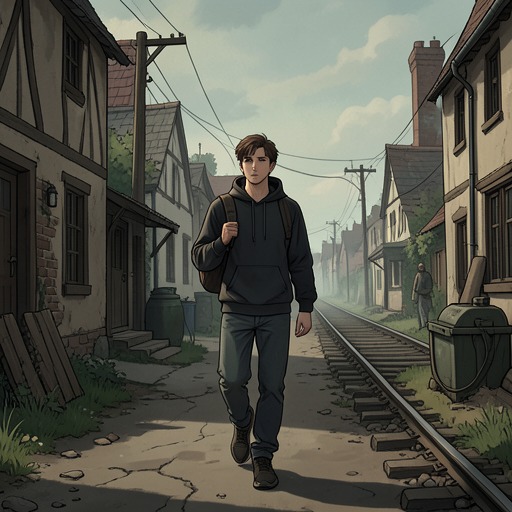
That image is complicated by the small practical hardships that shape his days. When his scooter breaks down in June, he has to walk everywhere. The damage begins with the ignition and spreads through its mechanical parts, leaving him without the mobility he depends on. In the ZUP, where midafternoon heat and inactivity seem to stretch time, he spends hours among other young men, irritated by the lack of customers and worried that their supply of hashish is drying up. His livelihood is precarious: he has seen few customers, suspects new sources of supply have appeared, and cannot count on his absent older brother to help. The boredom is not merely an atmosphere around him; it is one of the conditions under which his anxiety and resentment gather force.
Work, Anger, and the Motorcycle Feud
Hacine Bouali’s desire to get out of his immediate circumstances emerges as speed and risk. At seventeen, he races down the ZUP hill on a Yamaha, rides through downtown without braking, and continues onto the departmental highway. The episode links his private distress to a public spectacle: observers see a thin teenager on a fast motorcycle and draw political conclusions from the sight. The narration, meanwhile, registers how trapped he feels, describing a young life under pressure and a moment when death seems preferable to continuing as he is. His ride offers movement without a destination; he stops by a field of hay rolls rather than arriving at any durable alternative.
There, the object in his pocket connects his anger to class antagonism. Hacine Bouali plays with an old bronze-colored Zippo lighter he took from a student during middle-school exams. The stolen item belongs to a broader pattern of friction between pupils from the public school and wealthier students from Hurlevent, a private school downtown. Such thefts are described as small compensations in a low-grade class struggle, though the practice has diminished as the wealthier students learn to leave valuables at home. The lighter is both a personal possession and a trace of that unequal encounter: it gives Hacine Bouali a small trophy, but does not change the conditions that made the theft meaningful to him.
The disappearance of Anthony Casati’s Yamaha turns that background hostility into a direct conflict. Anthony and his cousin visit Le Grand to explain that the motorcycle vanished after a party where Hacine Bouali appeared, and they voice their suspicions. Later, Hacine Bouali sees Anthony approach on a scooter and recognizes him. He leaves the shelter and walks toward him as others begin to curse and move out from under cover. Anthony reaches into his backpack and produces a MAC 50. Hacine Bouali remains facing him despite his fear, acting on the lesson that, in his world, retreat can bring a lasting stigma. Anthony cocks the gun and considers firing; then the scooter stalls. The mechanical failure interrupts a confrontation poised to become fatal. It does not resolve the feud, but it reveals how completely the boys’ relationship has become organized around the possibility of violence—and how an unreliable machine can abruptly alter the balance between them.
Family Discipline and Return from Morocco
Hacine Bouali’s conflict with Anthony Casati is followed by violence at home. When he returns, his father is waiting and attacks him with an ax handle, then locks him in his room. The account establishes the severity of the assault without turning it into an explanation that excuses what follows: by morning, his father warns him never to repeat the offense, and Hacine Bouali says nothing. He is left ashamed and in pain, but also determined to find Anthony and his cousin. Family discipline therefore fails to extinguish the retaliatory impulse; instead, the threat of violence becomes part of the world in which he understands how to respond to humiliation.
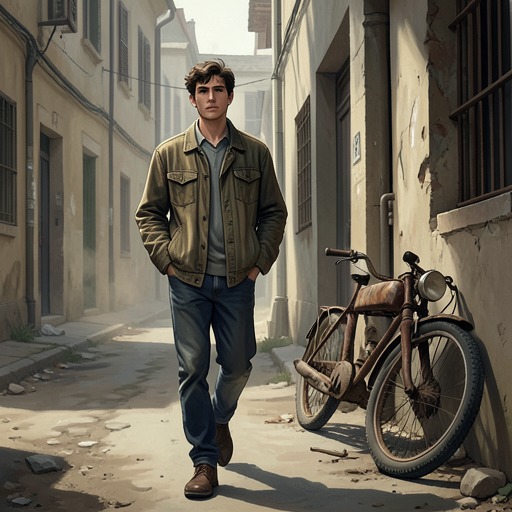
Two years later, Hacine Bouali returns to Heillange in his father’s Volvo station wagon. The return is the endpoint of an attempted reinvention in Morocco. On an earlier journey there, his father had packed goods to carry and resell, cut Hacine Bouali’s hair on the ferry, and supplied him with new clothes and leather shoes. The preparations made the trip a passage into adulthood as much as a journey between countries: he was expected to look presentable and learn how to live as a man. But after a series of disappointments, including the loss of a hoped-for relationship with Ghizlane, Hacine Bouali decides that becoming rich is the one goal that might hold off life’s continual losses. He throws himself into making money in Tétouan.
The attempt collapses into a costly investment failure. After a man takes their money and disappears, Hacine Bouali and Driss receive demands for further payments tied to projects in several Moroccan towns; their signatures appear on the documents authorizing the work. At first they ignore the letters, but abusive messages and threats follow. A fire in the stairwell of Hacine Bouali’s building deepens their fear, and Driss is later attacked and seriously injured. They pay what is demanded, and Hacine Bouali decides the enterprise is over. His father’s heart problems also help bring the decision home. He returns carrying fear, shame, and the last of his savings, a sharp contrast to the rumors that he has been prospering abroad.
Work, Exile, and Narrative Significance
The return does not make Hacine Bouali’s future secure. Earlier, he sits for a job-related appointment in a shabby ground-floor office at Heillange City Hall, cold after little sleep and clearly wishing to be elsewhere. The office, a former elementary school with long corridors and chilly stairwells, offers a different prospect from the informal trade that has occupied him, but the scene supplies no outcome: it shows him facing the possibility of conventional employment, not attaining it. His position remains suspended between unstable informal work and a route into a formal economy that has not yet opened.
Hacine Bouali’s story is built around repeated efforts to convert vulnerability into control. A broken scooter leaves him dependent on walking; a stolen lighter gives him a small emblem of defiance; speed briefly cuts through the dead time of the ZUP; and the pursuit of wealth promises an escape from loss. Each answer proves temporary. The motorcycle feud brings him within reach of death, punishment at home intensifies rather than ends his anger, and the Moroccan venture sends him back with less than he had hoped to secure. His movement between Heillange and Morocco is therefore not a simple departure and return. It shows how ambition can cross borders while the pressures of poverty, humiliation, and belonging travel with the person who leaves.